
Small Claims Court
If you are dealing with a legal dispute, understanding how small claims court in Nova Scotia works can help you save time, money, and unnecessary stress. Designed to be more accessible than higher courts, Small Claims Court offers a streamlined process for resolving certain types of disputes—especially where the amounts involved are more modest.
Here are six key things you should know before starting a claim.
1. There Are Time Limits to Bring a Claim
One of the most important aspects of small claims court in Nova Scotia is that you do not have unlimited time to start your case. Like all legal matters, claims are subject to limitation periods.
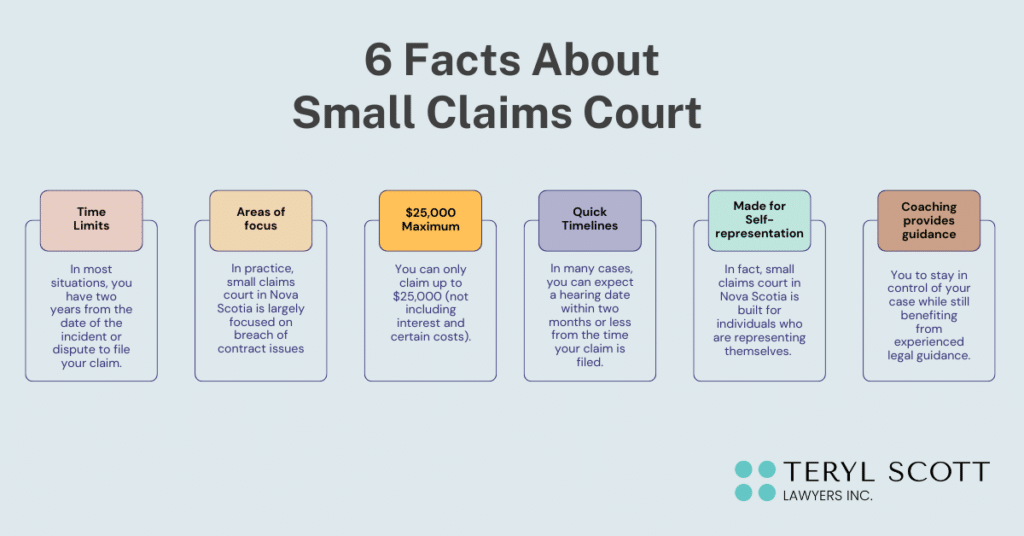
In most situations, you have two years from the date of the incident or dispute to file your claim. If you miss this deadline, you may lose your right to pursue compensation entirely—even if your case is otherwise strong.
Because of this, it is important to act promptly. If you are unsure when your limitation period expires, getting early guidance can make a significant difference.
2. Small Claims Court In Nova Scotia Is Primarily About Breach of Contract
Many people assume they can bring any type of dispute to Small Claims Court, but that is not entirely accurate. In practice, small claims court in Nova Scotia is largely focused on breach of contract issues—situations where one party has failed to meet their obligations under an agreement.
While you can pursue certain other claims, it is important to understand that non-financial damages are very limited. For example, damages for pain and suffering are capped at just $100.
This means Small Claims Court is best suited for disputes involving:
- Unpaid invoices
- Property damage
- Breach of service agreements
- Wrongful dismissal from employment
- Disagreements over deposits or fees
If your claim is more complex or involves significant personal injury, another court may be more appropriate.
3. There Is a $25,000 Monetary Limit to Small Claims in Nova Scotia
Another defining feature of small claims court in Nova Scotia is the monetary cap. You can only claim up to $25,000 (not including interest and certain costs).
If your claim exceeds this amount, you will need to bring your case to the Nova Scotia Supreme Court instead. In some situations, people choose to reduce their claim to $25,000 in order to stay within Small Claims Court and take advantage of its simpler process.
This decision should be made carefully, as you are giving up the ability to recover the full amount owed.
4. Hearings Are Relatively Fast in Nova Scotia Small Claims Court
Compared to other courts, small claims court in Nova Scotia moves quickly. In many cases, you can expect a hearing date within two months or less from the time your claim is filed.
This faster timeline is one of the main advantages of Small Claims Court. It allows individuals and businesses to resolve disputes without the long delays often associated with higher courts.
That said, preparation time is short—so being organized from the outset is critical.
5. The Small Claims Court Process Is Designed for People Without Lawyers
Small Claims Court is intentionally structured to be accessible. The procedures are simpler, the rules of evidence are more flexible, and the environment is less formal than in higher courts.
In fact, small claims court in Nova Scotia is built for individuals who are representing themselves. You are not required to have a lawyer, and many people successfully present their own cases.
However, “simpler” does not mean “easy.” You are still responsible for:
- Proving your claim
- Organizing your evidence
- Presenting your case clearly and logically
This is where preparation becomes the difference between success and frustration.
6. Legal Coaching Can Make a Significant Difference
Even though you may not need full legal representation, legal coaching with senior counsel can be a highly effective and cost-conscious way to prepare for your hearing.
Through legal coaching, you can get help with:
- Understanding the strengths and weaknesses of your case
- Preparing a clear and persuasive argument
- Organizing your documents into a proper exhibit book
- Ensuring all of your evidence is presented effectively to the adjudicator
This approach allows you to stay in control of your case while still benefiting from experienced legal guidance. For many people navigating small claims court in Nova Scotia, legal coaching strikes the right balance between affordability and preparedness.

Teryl Scott Lawyers – Your Small Claims Court Advantage
At Teryl Scott Lawyers, we understand that going to court—especially on your own—can feel overwhelming. That is why we focus on practical, results-driven legal coaching services tailored specifically for small claims court in Nova Scotia.
Our approach is designed to give you confidence and clarity at every stage of the process. We work with you to:
-Build a strong and organized case
-Prepare a professional exhibit book
-Anticipate what the adjudicator will be looking for
-Present your evidence in a clear, persuasive way
You remain in control of your case, while benefiting from experienced legal insight behind the scenes.
If you are preparing for Small Claims Court, having the right strategy and support can make all the difference. Call to book a consultation today.
Teryl Scott Lawyers Inc. Related Services
To learn more about the legal services we offer in Halifax and surrounding areas visit the following pages:
Employment Law Overview, Civil Litigation Legal Coaches, Property Disputes, and Small Claims Court Legal Coaches
Share with these links:
Follow us at these links: